Flock Cameras: What They Record and Who Can Search It
Flock cameras log your plate, make, color, time and place. Police share searches. Find cameras near you and erase the link to your home.

Key takeaways
- Flock cameras are license plate readers that log a still image "sighting" of each passing vehicle, including make, color, direction, time, location, and plate when visible. Flock says it has more than 120,000 cameras across 49 states.
- Agencies can opt into statewide and nationwide lookup networks to share searches. EFF reports at least 4,000 agencies can run searches through some agencies in Flock's network.
- USA Today analyzed more than 75 million Flock searches and found reasons like "SUS", "TEST" or a single letter. At least 19 police employees in five states were arrested, fired, put on leave or investigated over two months.
- DRN Data, owned by Motorola Solutions, has amassed more than 15 billion vehicle sightings from repossession trucks and other sources, and sells access to private investigators, repo agents and insurers.
- You can't erase the camera's sighting, but you can find cameras near you, check your city's transparency portal, and erase the name and home address that people-search sites attach to you.
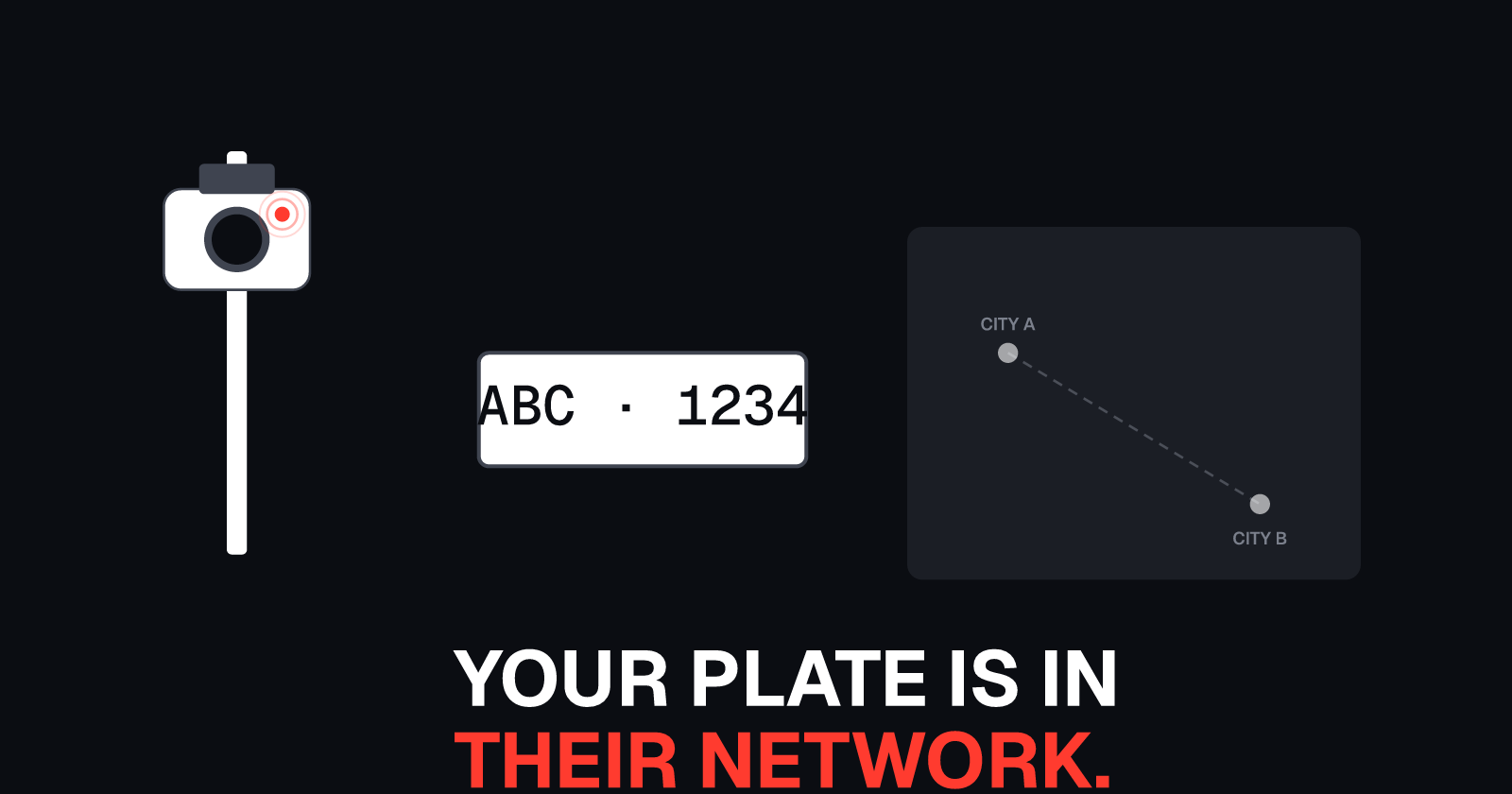
This camera just logged your car. Your plate, your car's color, the time, the place. And it's probably not the only one on your route.
Flock cameras are license plate readers, mostly used by police, that log a still image "sighting" of each passing vehicle. Flock says each sighting can include the make, color, direction, time, location, and plate when visible (Flock, Oct 19, 2026). Agencies can share searches across statewide and nationwide networks. You can't erase the camera's sighting, but you can see where cameras are, check your city's rules, and erase the name and home address that people-search sites attach to you.
Last updated: November 2, 2026
What are Flock cameras?
Flock cameras are automated license plate readers (ALPRs) that capture still images of passing vehicles. Flock Safety, the company that makes them, says it has more than 120,000 cameras across 49 states (Stateline, Aug 14, 2026). A researcher's map built from Flock's own device database counted more than 170,000 cameras (TrestleWire, Sept 2026).
The cameras are typically mounted on poles near roads and intersections. They're small, often with a solar panel on top and a dark lens. Most drivers pass them without noticing.
What does a Flock camera record?
Every time a car passes, a Flock camera captures still images. Flock says each sighting can include the make, the color, the direction of travel, the time, the location, and the plate, when it's visible (Flock, Oct 19, 2026).
Pass another camera, and that's another sighting. Line them up, and investigators can see where a car was seen over time. Each pass by another camera is a separate sighting.
Does Flock use facial recognition?
No. Flock says it does not use facial recognition or identify drivers (Flock, Oct 19, 2026).
But it doesn't need to. Police can match a plate to its registered owner. The camera records the car, and the plate connects the car to a person through DMV records.
Who can search Flock camera data?
Flock's main customers are police departments. And they can share. Agencies can opt into statewide and nationwide networks, so one search can reach cameras far from home.
The Electronic Frontier Foundation (EFF) reported in May 2025 that at least 4,000 agencies are able to run searches through some agencies in Flock's network (EFF, May 2025). Flock later stopped out-of-state searches of cameras in California, Illinois and Virginia (404 Media).
Every search requires a reason. Agencies log who searched, what they searched, and why.
How long is Flock data kept?
It depends on the agency. Local police departments and cities set their own retention periods.
Flock cut its recommended default retention from 30 to 7 days in August 2026 and made Audit Assistance (a tool that logs and flags searches) mandatory for all customers (Flock, Aug 13, 2026; Stateline). But existing customers keep their current retention periods.
If you want to know your city's retention period, check for a transparency portal (see below) or ask your police department.
Has Flock data been misused?
Yes. USA Today analyzed more than 75 million Flock searches from January 2023 to July 2026 across more than 6,300 agencies. Some of the reasons officers typed? "SUS", "TEST", or a single letter (USA Today, Aug 28, 2026).
In just two months, at least 19 police and sheriff's office employees in five states were arrested, fired, put on leave or placed under investigation (USA Today, Aug 28, 2026).
Court documents show a former Milwaukee police officer used Flock to search the location of his romantic partner 124 times (CNN, Aug 13, 2026).
Flock says its new Audit Assistance tool, now mandatory, logs all searches and flags suspicious activity. But the tool depends on agencies actually reviewing the alerts.
Who else scans license plates?
Police cameras aren't the only ones. Repo trucks drive around with plate cameras too, scanning the cars they pass.
Many of those scans feed a private company called DRN Data, owned by Motorola Solutions. WIRED reported DRN has collected more than 15 billion vehicle sightings, partly from "affiliate" cameras on repossession trucks (WIRED, Oct 3, 2024).
DRN's customers include insurers, lenders, repo agents and private investigators. Vigilant gives police access to the same data (WIRED, Oct 3, 2024).
DRN markets "Radius Response" to insurers to detect a vehicle operating outside its designated radius (drndata.com/insurance). And those cameras don't only see plates. WIRED found DRN search results included lawn signs and bumper stickers outside homes, each with date, time and location (WIRED, Oct 3, 2024).
DRN is not Flock. It's a separate network, and most people have never heard of it.
How do I find Flock cameras near me?
You can't see an official map, but you can see reported locations.
Step 1: Find the cameras near you
DeFlock's crowdsourced map (deflock.org) shows reported plate readers across the country. In October 2026, MapQuest added a Surveillance Layer to its app that plots them on your route (Engadget, Oct 16, 2026).
Both show reported locations, not an official inventory. But they're the closest thing to a public map.
Step 2: Check your city
Some police departments publish a Flock Transparency Portal, with camera counts, how long data is kept, how many searches were run, and who else can search it.
No portal? Ask your police department or city council. Local agencies set retention and sharing rules. You have a right to ask.
Step 3: California residents, send DRN a privacy request
If you live in California, you can send DRN (Digital Recognition Network) a privacy request to know or delete the personal information it holds about you.
Email: privacy@drndata.com with subject "California Rights Request", or call 1-800-538-4427 (DRN privacy page).
DRN says it may decline or limit requests and some data is excluded. Exceptions can apply, but you're allowed to ask.
Step 4: Erase the link to your front door
A plate on its own isn't your name. The Driver's Privacy Protection Act generally blocks using a plate to get the owner's name and address from DMV records (NY DMV).
But a stranger doesn't need your plate. Type your name into a people-search site, and many will show your home address. The FTC says these sites collect your information and sell it (FTC).
That part, you can erase. Opt out of people-search sites one by one. Then check again, because listings come back.
Our complete guide to removing your personal information from the internet walks through every major site. TruePeopleSearch removal, BeenVerified opt-out, and our 30-day plan break it down step by step.
California residents can use DROP to send one free deletion request to over 600 registered data brokers.
What can I actually erase?
Here's the thing. You can't erase a camera on a pole. You can't delete a sighting that's already in the system.
But you can erase what turns your plate into your front door.
A plate reader logs your car. People-search sites log your name and home address. Put them together, and a stranger can find where you sleep at night.
The camera? That's outside your control. Your home address listed on Whitepages, Spokeo, TruePeopleSearch and dozens of other sites? That part, you can erase.
Start with a free scan at undoleak.com to see which people-search sites list your home address.
Then opt out site by site, or let UndoLeak do the heavy lifting. UndoLeak erases your data from data brokers and keeps it off, re-checking and erasing it again when it comes back.
Related reading
- Is Your Car Tracking You for Insurance? The OnStar Case - GM's OnStar Smart Driver shared trip data with LexisNexis, who sold it to insurers
- Why Data Brokers Re-List You After Opt-Out - Why your information comes back and what to do about it
- How to Remove Your Address From Google - Use Google's Results about you tool
- LexisNexis Report Request: Your Complete Guide - How to request your free LexisNexis consumer disclosure report
Quick recap
- Flock cameras are license plate readers that log every passing vehicle. Flock says it has more than 120,000 cameras across 49 states.
- Police can share searches across statewide and nationwide networks. At least 4,000 agencies can run searches through some agencies in Flock's network.
- Searches have been misused. USA Today found reasons like "SUS" or "TEST". At least 19 officers were arrested or fired over two months.
- The private network DRN has collected over 15 billion vehicle sightings and sells access to insurers, repo agents and private investigators.
- Find the cameras near you with DeFlock's map or MapQuest's Surveillance Layer.
- Check your city for a Flock Transparency Portal, or ask your police department.
- California residents can send DRN a privacy request to know or delete personal information.
- Erase the link to your home by opting out of people-search sites that list your name and address.
Sources
Accessed November 2, 2026.
- Flock Safety, "How Flock LPR cameras work: what they capture, what they don't, and the guardrails around their use" (Oct 19, 2026), https://www.flocksafety.com/blog/how-flock-license-plate-reader-cameras-work-what-they-capture-what-they-dont-and-the-guardrails-around-their-use
- Flock Safety, "Flock Safety Guardrails Address LPR Privacy Concerns and Police Transparency" (Aug 13, 2026), https://www.flocksafety.com/blog/flock-guardrails-address-lpr-privacy-concerns-and-police-transparency
- Stateline, "Flock Safety Tightens Safeguards as States, Cities Question Surveillance Network" (Aug 14, 2026), https://stateline.org/2026/08/14/flock-safety-tightens-safeguards-as-states-cities-question-surveillance-network/
- TrestleWire, "Flock Safety Camera Count Map Sparks Trademark Complaint" (Sept 2026), https://www.trestlewire.com/article/flock-safety-camera-count-map-trademark-complaint
- USA Today, "Flock camera investigation: Police arrested, fired over surveillance searches" (Aug 28, 2026), https://www.usatoday.com/story/news/nation/2026/08/28/flock-camera-investigation-police-arrested-fired-surveillance/91383586007/
- CNN, "Flock cameras: Police push back on auditing and oversight controls" (Aug 13, 2026), https://www.cnn.com/2026/08/13/tech/flock-cameras-police-auditing-controls
- 404 Media, "Flock Removes States From National Lookup Tool After ICE and Abortion Searches Revealed", https://www.404media.co/flock-removes-states-from-national-lookup-tool-after-ice-and-abortion-searches-revealed/
- Electronic Frontier Foundation, "She Got an Abortion, So a Texas Cop Used 83,000 Cameras to Track Her Down" (May 2025), https://www.eff.org/deeplinks/2025/05/she-got-abortion-so-texas-cop-used-83000-cameras-track-her-down
- WIRED, "License Plate Readers Can Photograph Your Political Signs, Bumper Stickers" (Oct 3, 2024), https://www.wired.com/story/license-plate-readers-political-signs-bumper-stickers/
- DRN Data, "Insurance", https://drndata.com/insurance/
- DRN Data, "Privacy and Security Statements", https://drndata.com/privacy-and-security-statements/
- DeFlock, https://deflock.org/
- Engadget, "MapQuest will now show you where Flock cameras are in your neighborhood" (Oct 16, 2026), https://www.engadget.com/2288729/mapquest-will-now-show-you-where-flock-cameras-are-in-your-neighborhood/
- NY DMV, "Driver's Privacy Protection Act (DPPA)", https://dmv.ny.gov/records/drivers-privacy-protection-act-dppa
- Federal Trade Commission, "What To Know About People Search Sites That Sell Your Information", https://consumer.ftc.gov/articles/what-know-about-people-search-sites-sell-your-information
Disclaimer: Dana Ruiz, plate DRZ 3417, and every screen shown are fictional recreations, not real people, plates or screenshots. General information, not legal advice. UndoLeak is not affiliated with Flock Safety, DRN, Motorola Solutions, DeFlock, MapQuest or any outlet named.
Frequently asked questions
What are Flock cameras?
Flock cameras are automated license plate readers (ALPRs) that capture still images of passing vehicles. According to Flock Safety, each sighting can include the license plate (when visible), make, color, direction of travel, time and location. Flock says it has more than 120,000 cameras across 49 states and that it does not use facial recognition or identify drivers.
What does a Flock camera record?
Flock says a sighting can include the vehicle's make, color, direction of travel, time, location and the license plate when it's visible. Each pass by another camera is a separate sighting. Flock says it does not use facial recognition or identify drivers.
Who can search Flock camera data?
Flock's main customers are police departments. Agencies can opt into statewide and national lookup networks, allowing searches across multiple jurisdictions. EFF reported in May 2025 that at least 4,000 agencies are able to run searches through some agencies in Flock's network.
How long is Flock data kept?
Flock cut its recommended default retention from 30 to 7 days in August 2026 and made Audit Assistance mandatory for all customers. However, existing customers keep their current retention periods. Local agencies set their own retention rules.
Has Flock data been misused?
USA Today analyzed more than 75 million Flock searches from January 2023 to July 2026 across 6,300+ agencies and found reasons like "SUS", "TEST" or a single letter. At least 19 police and sheriff's office employees in five states were arrested, fired, put on leave or placed under investigation over two months. Court documents show a former Milwaukee police officer used Flock to search the location of his romantic partner 124 times.
Does Flock use facial recognition?
No. Flock says it does not use facial recognition or identify drivers. The cameras capture still images of vehicles and license plates, not faces.
Who else scans license plates besides police?
DRN Data, owned by Motorola Solutions, has amassed more than 15 billion vehicle sightings, partly from "affiliate" cameras on repossession trucks. DRN's customers include private investigators, repo agents and insurers. Vigilant gives police access to the same data.
How do I find Flock cameras near me?
DeFlock's crowdsourced map (deflock.org) shows reported plate readers across the country. MapQuest added a Surveillance Layer to its app in October 2026. Both show reported locations, not an official inventory.
Can someone find my name and address from my license plate?
The Driver's Privacy Protection Act generally prohibits using a plate number to obtain an owner's name and address from DMV records, with certain permitted-use exceptions. However, people-search sites collect and sell names, addresses and phone numbers without needing a plate number. Anyone can type your name into a people-search site and see your home address.
What can I actually erase?
You can't erase a camera's sighting, but you can erase your name and home address from people-search sites that make it easy for anyone to find where you live. Opt out of each site individually, then re-check on a schedule because listings come back.
Are Flock cameras legal?
Flock camera deployment is legal in most jurisdictions and is typically decided by local police departments and city councils. Local agencies set retention and sharing rules. Some cities have transparency portals that show camera counts and policies. If your city doesn't have one, you can ask your police department or city council for information about camera use and policies.
undoleak Team