Data Brokers Re-List You After You Opt Out (Here's How to Stop It)
You opted out and your listing came back. Here's why data brokers re-list you, the five ways it happens, and how to make an opt-out stick with California DROP.

Key takeaways
- Most opt-outs hide your listing rather than erasing your data. When brokers refresh their databases from new records, you reappear.
- Five reasons listings come back - new records, unmatched variations of your name or address, sister sites, other people's reports, and opt-outs that expire.
- California's DROP forces registered brokers to re-check and delete you every 45 days. Outside California, you have to re-check yourself.
You submitted an opt-out form in May. The site confirmed removal within 48 hours. In August, you searched your name again and found yourself back on the same site - same name, same address, a new profile URL.
It's not a glitch. Data brokers explain this in their own help pages. Here's why listings come back, how to make an opt-out stick, and the one legal mechanism that forces brokers to keep deleting you.
Quick answer: Brokers keep collecting new data from public records and other sources. Opt-outs often hide rather than erase you. New records - a move, a new phone number, a relative's report - create new listings your old opt-out doesn't cover. Opt out with every version of your info, start with network requests like PeopleConnect that cover multiple sites, log everything, and recheck twice a year or after any address change. California residents can use DROP, which forces registered brokers to re-delete you every 45 days.
Every fact below comes from data broker help pages, the FTC, Consumer Reports or California's Delete Act. Last checked October 19, 2026.
Why your information comes back: five reasons
Reason 1: Hidden, not erased
Most opt-outs don't erase your data. They hide it.
PeopleConnect, the company behind TruthFinder, Instant Checkmate, Intelius and USSearch, literally calls its opt-out tool a Suppression Center. The FAQ explains what that means: "Your Background Report... will not be provided if a user attempts to search you by name" (PeopleConnect).
Hidden from a name search. Not erased.
And some opt-outs come with an expiration date. The credit bureaus' opt-out for prescreened credit offers lasts five years unless you mail in the permanent form. DMA Choice, the marketing mail list, expires after ten years (FTC).
Reason 2: The refresh
Brokers keep pulling in new data from public records, other data brokers and public social profiles. The FTC says it plainly: "if the information in your public records changes, your information could re-appear for sale" on people-search sites (FTC).
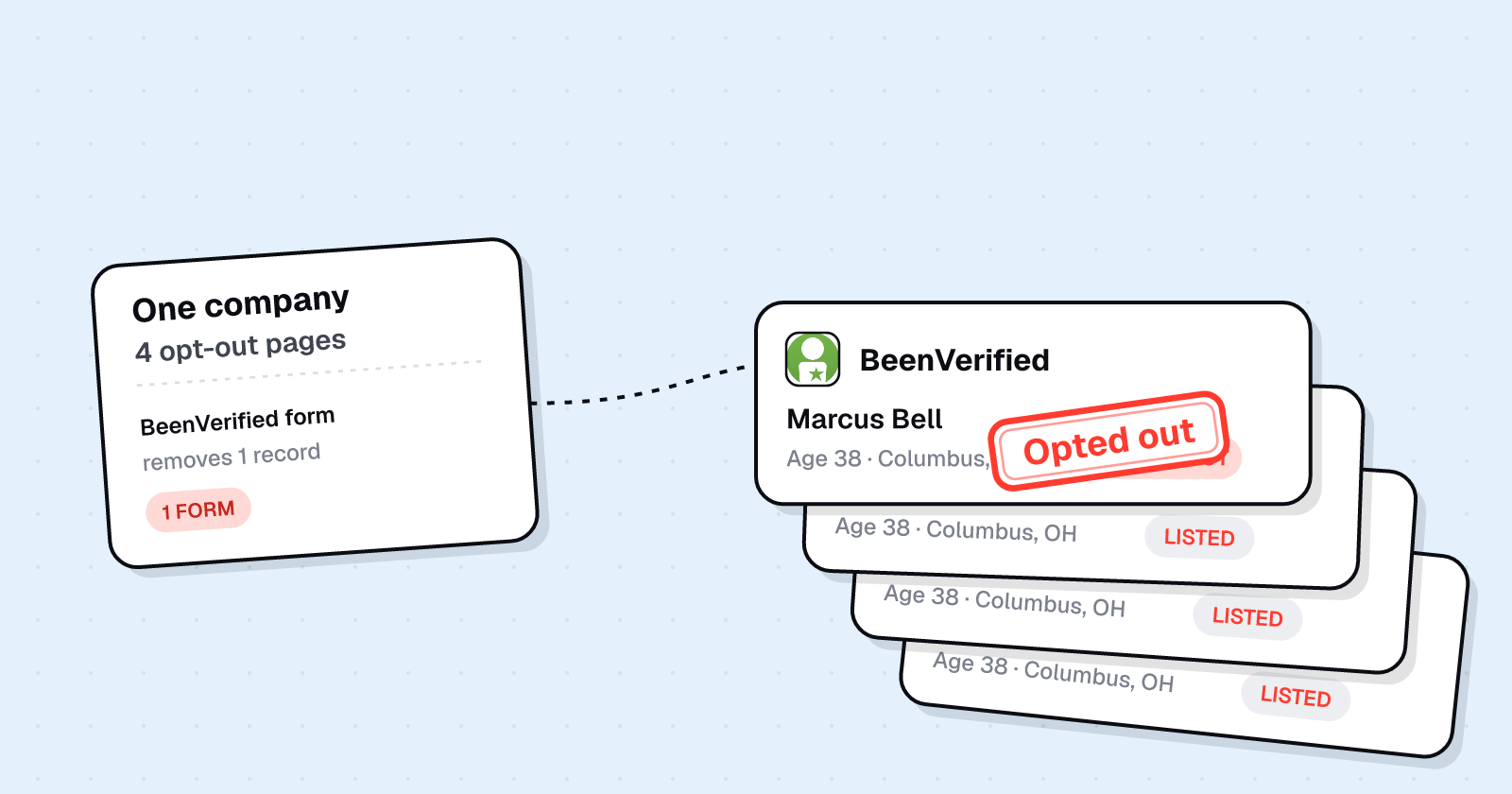
BeenVerified's help page explains how this creates new listings. When the site receives a new record that's different enough - a different spelling, initials, or a new address - it can't match the new record to the one you opted out. So it becomes a separate record, and it shows up in search (BeenVerified Help Center).
A common trigger: you move and update your voter registration. New record, new address, new profile. Your opt-out was attached to the old one.
Reason 3: One listing at a time
Many opt-out forms remove only one record.
BeenVerified states this directly: "we only permit you to remove one record from our People Search Results through our online... Opt-Out process. If you find more than one record... contact us at privacy@beenverified.com" (BeenVerified Help Center).
And that opt-out only affects BeenVerified's People Search. Your name might still show up in the site's other search tools, such as reverse phone or address lookups (BeenVerified; PeopleLooker Help Center).
Reason 4: Sister sites
Privacy Guides points out that most people-search sites are run by a small handful of companies (Privacy Guides). The FTC adds that these sites buy information from other data brokers (FTC).
So your data doesn't live on one site. It lives in a network.
One PeopleConnect suppression covers four sites. Skip it, and you're on all four. And when a new site launches in the same network, it can buy the same data and list you again on a site you've never heard of.
Reason 5: Other people's reports
The FTC warns that "your information may still appear in the reports of your relatives, neighbors, or associates" even after you opt out (FTC).
Your own page is gone. Your mother's page still lists you, with your phone number, under "relatives" or "associates."
How to make an opt-out stick
Here's a maintenance plan that actually works.
1. Opt out with every version of you
Old addresses, old phone numbers, maiden name, nicknames, middle initial. Mismatches are how new records slip through the opt-out you already filed.
When you find a listing, check whether the site has others under slight variations. Most sites let you search by name, phone and email. Search all three.
2. Start with the networks
One PeopleConnect suppression request covers four sites: Intelius, Instant Checkmate, TruthFinder and USSearch (opt-out form).
That saves time and closes four doors at once. Then work down to the smaller sites.
Our main removal guide has the 15 biggest sites with their opt-out links and what each one requires.
3. Search by phone number and email, not just your name
Brokers index records multiple ways. A listing might not show up under your name but will appear in a reverse phone search.
And check the listings of people you live with. The FTC notes your info can appear on a relative's report (FTC).
4. Put it on a schedule
Consumer Reports suggests treating removal as maintenance, at least twice a year (Consumer Reports, 2024). If you're at higher risk - law enforcement, a judge, a domestic violence survivor, a public figure - check every three months.
Privacy Guides recommends rechecking every 3, 6 or 12 months depending on your risk level (Privacy Guides).
Do it right away after you:
- Move
- Change your phone number
- Buy property
- Update voter registration
These are the events that create new public records brokers copy.
5. Keep a log
| Site | Listing URL | Date submitted | Confirmed | Re-checked |
|---|---|---|---|---|
| Spokeo | spokeo.com/Name-Name/... | Oct 12 | Yes | Jan 11 |
| Whitepages | whitepages.com/name/... | Oct 12 | Waiting |
When a listing comes back, you'll know it's a re-listing, not something you missed.
Use our free people-search check to build Google searches for 39 sites at once.
California DROP: the legal fix for re-listing
California residents have the strongest tool in the country.
DROP (Delete Request and Opt-out Platform, at privacy.ca.gov/drop) was created by California's Delete Act. It lets you send one deletion request to more than 600 registered data brokers (CalPrivacy).
Here's why DROP matters for this problem:
Registered brokers must re-check every 45 days
Since August 1, 2026, registered brokers must check DROP at least every 45 days and delete matching data, including inferences they've made about you (CalPrivacy).
After deleting you, they must keep deleting you
California Civil Code § 1798.99.86(d)(1) states that after a broker deletes your data, it "shall delete all personal information of the consumer at least once every 45 days" (Delete Act statute).
Subsection (d)(2) adds that the broker "shall not sell or share new personal information of the consumer" (Delete Act statute).
That's a law aimed straight at re-listing. Instead of you having to remember to re-check, the broker is legally required to keep checking and deleting.
Fines for non-compliance
Brokers that don't comply can be fined $200 per day per request (CalPrivacy; CPPA).
Limits
DROP only covers:
- California residents
- Registered data brokers (about 654 as of August 2026)
- Non-exempt personal information (some public records are exempt)
It doesn't remove Google results or pages on unregistered sites. You'll still need Google's Results about you and individual opt-outs for anything DROP doesn't reach.
Status updates can take up to 90 days. By late August 2026, more than 500,000 Californians had signed up, and by October 9, brokers had reported deleting more than 60 million profiles (CalPrivacy; Bloomberg Law).
Our full DROP walkthrough explains how to file, what each status means, and why adding old addresses helps brokers match your records.
If you live outside California
Connecticut passed a similar system that launches July 1, 2028 (Connecticut Public Act 26-64).
Until then, the re-checks are on you. Treat it as twice-a-year maintenance, or use a monitoring service that re-files for you.
Opt-outs that cover multiple sites
These requests save you time by covering several sites at once:
| Network | Sites covered | Opt-out URL | What you need |
|---|---|---|---|
| PeopleConnect | Intelius, Instant Checkmate, TruthFinder, USSearch | suppression.peopleconnect.us | Email verification, then pick your report |
| BeenVerified family | BeenVerified, PeopleLooker, NeighborWho | Separate opt-outs, but same company | Email for each |
PeopleConnect's tool is the most useful: one request, four sites. The FAQ notes that suppression stops your report from showing "when someone searches you by name," though reverse phone or address searches can still show you (PeopleConnect).
Our people-search site owners lookup shows when one opt-out covers several sites.
DIY maintenance versus removal services
Can you pay someone to handle the re-checks? Yes. Here's what that gets you.
In Consumer Reports' 2024 study, manual DIY opt-outs removed about 70% of tracked profiles at four months, while paid services removed about 35% on average, ranging from 4% to 68% (Consumer Reports, 2024). The study did not check whether deleted profiles reappeared, so there's no public data on which approach prevents re-listing better.
What a service actually does
Incogni and DeleteMe both re-check on schedules:
- Incogni: requests re-sent every 60 days (public brokers) or 90 days (private brokers) (Incogni)
- DeleteMe: monitors each broker "on a reliable cadence" with four reports per year, one every three months (DeleteMe Help Center)
The value is saving time and remembering for you. The FTC says to periodically check people-search sites and submit new opt-outs as needed (FTC). Services automate that loop.
Where services fall short
- They can't prevent re-listing any better than you can. Brokers rebuild profiles from new data regardless of who filed the opt-out.
- Coverage varies. Ask which sites a service covers. Some publish lists; others don't.
- You're still trusting them with your details. Read the privacy policy, especially what happens if the company is sold.
Our DeleteMe vs Incogni vs DIY comparison breaks down cost, coverage, re-check schedules and what Consumer Reports found.
A simple twice-a-year plan
Copy this into your calendar:
First pass (January or now):
- Create a tracker: site, listing URL, date, confirmation, re-check date
- Search Google for your name + city, past addresses, phone and email
- Opt out of PeopleConnect Suppression Center (covers 4 sites)
- Opt out of the top 15 sites from our main guide
- California residents: file DROP at privacy.ca.gov/drop
- Set up Google Results about you notifications
30 days later:
- Re-check every listing URL
- Re-submit any that are still live
Six months later (July):
- Repeat the full Google search
- Check for new listings
- Opt out of anything new
- California: check DROP status
Every six months after that:
- Repeat
Right away after a move, phone change or property purchase:
- Run the full check within two weeks
What won't work
Asking brokers to stop collecting new records. They're allowed to compile public records and buy data from other brokers. Opting out only stops them from showing or selling what they already have.
Assuming one opt-out removes you from everything. Each site needs its own request. Many listings on the same site need separate requests.
Ignoring relatives' reports. If your mother's listing shows your phone number, opting out of your own page doesn't remove it from hers. Check her listings too.
Forgetting about sister sites. Most people-search sites won't share an opt-out with each other unless they're part of a network like PeopleConnect. Assume each site needs its own request unless the opt-out confirmation says otherwise.
Conclusion
Opting out stops a broker from selling the data it has now. It doesn't stop the broker from collecting new data tomorrow. That's why listings come back, and why removal is maintenance, not a one-time fix.
Start with networks like PeopleConnect that cover multiple sites. Opt out with every version of your info - old addresses, maiden names, phone numbers. Keep a log. Recheck twice a year and after any move.
If you live in California, DROP forces registered brokers to re-delete you every 45 days. Outside California, the re-checks are on you - or on a service you pay to remember for you.
Search your own name tonight. You might be surprised how many listings came back since the last time you checked.
Sources
- FTC Consumer Advice, What To Know About People Search Sites That Sell Your Information
- BeenVerified Help Center, How do I remove my name from BeenVerified's people search results? (updated Jan 6, 2026)
- PeopleLooker Help Center, When I Opt Out, Will Data About Me Ever Reappear?
- PeopleConnect, Suppression Center (Intelius, Instant Checkmate, TruthFinder, USSearch)
- FTC, How To Stop Junk Mail (prescreened offers and DMAchoice expiration)
- Privacy Guides, Data broker removals
- Consumer Reports and Tall Poppy, Data Defense: Evaluating People-Search Site Removal Services (Aug. 2024)
- California Privacy Protection Agency (CalPrivacy), DROP and Processing DROP requests
- Delete Act statute, Cal. Civ. Code § 1798.99.86, PDF
- CalPrivacy press release, Half a Million Californians Have Signed Up for DROP (Aug 25, 2026)
- Bloomberg Law, California Data Brokers Report Over 60 Million Profile Deletions (Oct 9, 2026)
- Connecticut Public Act 26-64 (SB 4), PDF (accessible deletion mechanism by July 1, 2028)
- Incogni, Incogni vs DeleteMe comparison (re-scan schedules)
- DeleteMe Help Center, Do you constantly monitor my info around the clock? (updated Aug 13, 2025)
Frequently asked questions
Why does my information keep coming back after I opt out?
Opting out stops a site from showing what it already has. It doesn't stop the site from buying new data or scraping new public records. When you move, change your phone number or a relative's report lists you, the broker creates a new record that your old opt-out doesn't cover.
How often do data broker listings come back?
It varies by site and how often your public records change. Consumer Reports suggests treating removal as twice-a-year maintenance. If you move, buy property or change your phone number, check within weeks.
What is suppression versus deletion?
Suppression hides your listing from name searches but keeps your data. PeopleConnect's Suppression Center is an example. Deletion removes the data entirely, though brokers can still rebuild it from new records. Check each opt-out form's language.
Do opt-outs expire?
Some do. The credit bureau prescreened-offer opt-out lasts five years unless you mail the permanent form. DMAchoice lasts ten years. Most people-search sites don't publish an expiration date, but they warn listings can reappear without notice.
How does California DROP stop re-listing?
California's Delete Act requires registered brokers to check DROP at least every 45 days and delete matching data each time. After a broker deletes you, it must keep deleting you and can't sell new data about you. That's a legal mechanism aimed at re-listing.
Can I stop my information from appearing on other people's reports?
Not completely. The FTC warns your info may still show up in relatives' or neighbors' reports even after you opt out. Search their names, check their listings, and opt out of pages that list you.
What's the difference between removing one listing and removing all of them?
Many opt-out forms remove only one record. If you have multiple profiles on the same site, each needs its own request. BeenVerified's help page explains this - one online opt-out removes one record; more than one requires emailing them.
Do sister sites share opt-outs?
Sometimes. PeopleConnect's Suppression Center covers Intelius, Instant Checkmate, TruthFinder and USSearch with one request. But most sites require separate opt-outs even when owned by the same company. Check the opt-out confirmation to see which sites it covers.
Should I use a monitoring service or do it myself?
If you have a few hours twice a year and only a handful of listings, DIY works as well as any service. If you want to save time and get automatic re-checks, paid services handle the maintenance. Our comparison of DeleteMe vs Incogni vs DIY breaks down what each option gets you.
undoleak Team